This calculates SoC using voltage, not through current flow, and it’s very accurate in my testing.
1 Like
There is a 10A model from a company called shavison.
Also easy enough to build your own as all parts are available in modular form on sites like robu
2 Likes
Thanks for posting this. The model DCUPS-1-120-12 is exactly what we need, assuming it does proper lead acid battery charging. Bulk + float.
@rsaeon take a look at this. If this truly works then we are just reinventing the wheel.
I have to check how to order this.
1 Like
24v version is available on amazon but i cant find 12v one. I guess you would have to contact them.
3 Likes
Between the Shavison one for lead acid batteries and the Energy Intelligence units mentioned by @jaws with internal lithium batteries, it does look like we’re late to the market, haha.
5 Likes
So I went through the datasheet first thing I spot.


Their recommended battery is
Battery rating: 12V / 7AH, 12AH SMF BATTERY
This is not going to work for us, we want to use inverter tubular battery for long backups.

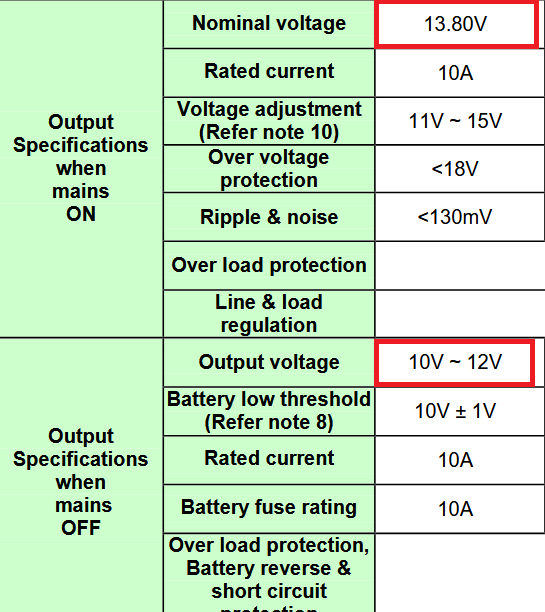
This might be okay or not, depending upon how many 12V devices we hook up.
In my design this is should be 0. No voltage drop.
Output voltage is not exactly 12V, we still have to use the buck/boost.
1 Like
There is nothing in the market that offers uninterruptible DC UPS, with 0 transfer time, takes in typical inverter batteries and does proper 3 stage charging of it.
- Bulk
- Absorption
- Float
@Heisen I wouldn’t write off your idea just like that. Mean Well makes excellent DC UPS modules, especially their ADD-155A/B/C series. I have series A module, which I replaced with the Energy Intelligence UPS. I was pretty happy with the ADD unit while I had it powering my network rack. I replaced it with an off the shelf Energy Intelligence unit to (1) reduce the bulk of lead acid batteries and (2) to get rid of the rat’s nest of wiring that came with this kind of setup. And of course the itch of trying something new 
The only problem with ADD-155A/B/C is that it outputs battery voltage, what that means is the unit would output 13.5 V with a fully charged/charging battery but could output lower than 12V when discharging. And that is why I needed an additional (Mean Well again!) unit to stabilise output voltage to 12V.
2 Likes
Unless I am wrong.
I looked at those, they don’t implement proper 3 stage lead acid battery charging algorithm, that our typical inverters do.
They just output a float voltage for the battery.
The reason I am after lead-acid battery is because of simplicity and lower replacement cost.
1 Like
TIL! I did not know 3 stage chargers and their benefits. Looks like Mean Well’s ENC series implements 3 stage charging.
1 Like
It does, but it is just a charger (real nice one). If we put load on the battery while it is charging, it can mess it up.
1 Like
Industrial units like these are not meant to be plug & play.
You are trying to solve for a non common use case so getting your hands a bit dirty will be needed
If you want to keep it less DIY,
Just get a prebuilt DC-DC UPS like the shavison one.
If you want exactly regulated 12V output, add a buck boost converter like this one. This one eg will take 8V to 40V for a o/p of exact 12V
If you are OK getting your hands a little dirty but not to the extent of building a PCB and soldering components:
A) Get a meanwell 12V 10/15A supply based on your load. Set output to 13.8V
B) A XH-M609 or similar undervoltage board and set it to 11.2V or whatever depth of discharge you are comfortable with
C) you can use a relay driven changeover but thats not necessarily required
C) add the 8-40V DC SMPS linked above to get exact 12V o/p with zero failover (or short failover if you add a relay)
You can add 3 stage charging module also but unless you are looking at frequent and long discharge cycles, a lead acid floated at 13.8 vs a Lead acid taken to 14.2 and then to 13.8 will have minimal life difference. I personally skipped this
1 Like
No, it doesn’t. As long as your power supply is beefy enough to handle the load needed by battery and provisioned load. Eg for a 60W load a 12 AH battery, a 15 A supply will be adequate to top up your battery and handle the load concurrently.
I also just saw you need tubular - in which case the best option for you would be to go with a relay based changeover coupled with a transformer style charger as used in inverters
but before getting there, whats the load you have in mind and what are the power faiulure durations you want to cover for
1 Like
I am under the impression that for any kind of proper lead-acid battery charger, the only way for it to know if the battery is fully charged is by measuring how much current it is consuming.
When we add our load to the battery, the charging current parameter of the charger will be fooled. To switch the charging mode from the absorption stage to float stage, the trigger for this is current tapering off, but with our load connected it will never happen.
And the proper lead-acid charger will continually supply 14.8V and might never switch back to the float charging at 13.5V. This will damage the battery.
Simple solution here is to just set the normal power supply to the float voltage of the battery. If we are only discharging the battery by a small amount, or our load is very small, this is probably fine.
But if we have a situation where we are discharging the battery to 50-60% occasionally and we only charge it up back to the float voltage, this is damaging in the long run.
Float voltage 13.5V is designed to maintain a already fully charged to 14.4-14.8V battery not to recharge one.
Yup.
This is a must.
Yeah the difference might not be enough, but this is where the fun is, at least of me, making something that is not available.
1 Like
Just set it to 13.8V and forget about it.
Unless you are looking at full charge -discharge cycles on a regular basis
No.It does not work that way.
Lets say your battery is at 50% depth of discharge (12.0V)
Now your regulated output is set to 13.8V (and provided you arent overloading the supply). the AC-DC smps will try and equalize the potential difference between the load side (0V), battery (12.0V) and itself (13.8V) till they all balance out.
Once the battery hits 13.8V, the current pulled by the battery will taper down to zero while your load (say 60W) will keep pulling 5A
The 14.2V topup is required only for scenarios where you are bringing down the battery to near 100% DOD
PS: An easy way to safeguard against deep discharge cycles is to use a low voltage cutoff module (eg XH-M609) and set the low cutoff to something like 12V (choose the cutoff depending on how important battery longevity is for you)
With something like a 50%-100% cycle range, a constant feed of 13.8V will be enough and more to keep your battery running for long
If you want to safeguard the battery more (not worth it given the low cost), you can always bump up the cutoff threshold
3 Likes
Correct, this behavior is with using a simple power supply set to 13.8V.
If we add smart lead acid battery charger and put load on the battery that is where things start to slide.
Got it. 
1 Like
You have got me thinking now.
I have one DIY dc dc smps for NAS/Proxmox/ opnsense router at home . This uses a 7AH lead acid as max backup needed is few mins ( DG backup + outages in Pune are anyway short lived.)
I need to setup something similar in a different location. The load is lower. Maybe around 30-40W (2 ISP router, 1 LB, 3 sec cams at 48V, 3 APs at 48V and a couple of switches/misc )
But the site is unattended and power outages can be longer so need backup of at least few hours.
I was planning to use a 12AH lead acid but wondering if i should go lifepo4 instead since it seems the cost diff is minimal at least for lower capacity units
Is this something you havce explored?
1 Like
I had no idea @superczar was a such a GOATed electronics guru.
brb, going to learn everything I can from his post history.
1 Like
I really doubt that’ll be an issue. Pretty much any off-the-shelf UPS is designed to charge the battery and handle a full load simultaneously. The battery only actually kicks in as the power source when the AC goes out.
There is no dedicated output for connecting the load. So I assume load will be connected to the battery terminals where this charger will be connected.
But look at this, in the datasheet.
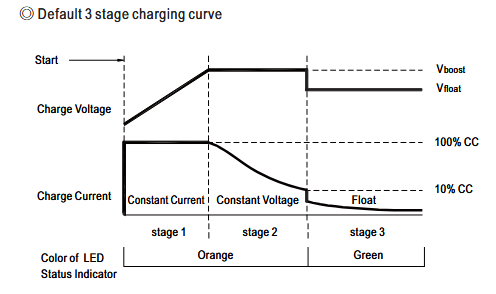
We can configure the Vboost, Vfloat and Constant Current parameters.
By measuring CC it is able to switch the charge stages. Float charging state triggers when CC reaches 10% of it original set value.
If we connect our load, CC will never drop down to 10%.
But huge thanks for introducing me to this device. It’s way too good for what it is. Every thing is programmable.
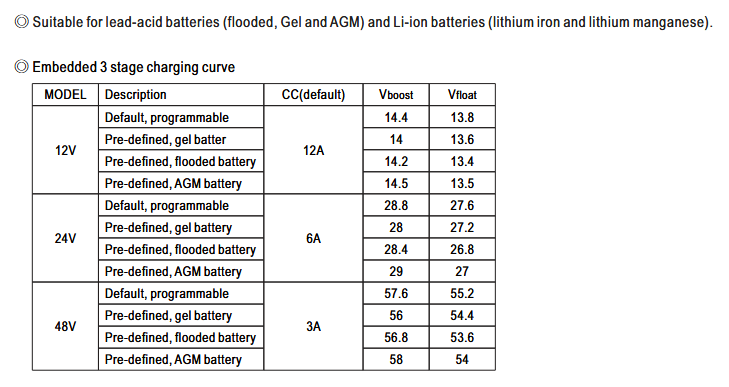
This single charger can charge all kinds of lead acid and lithium ion based batteries with pin point precision, that in itself is crazy. 
3 Likes