Teardown & Review of BLUETRAX 3KVA Step Down Transformer 220V to 110V

Currently out of stock: BLUETRAX 3000VA Step Down Voltage Converter Transformer 220V to 110V for US Appliances in India Compact Safe Lightweight Copper Core Efficient for Home Office Kitchen Electronics : Amazon.in: Home & Kitchen

So we have a few 110V kitchen appliances that we received as gifts during the good old days and I’ve been thinking about putting them to use.

At first, I wanted to build one but your favourite chatbot told me that there are safety measures to keep in mind like fuses, proper ratings, etc so I went ahead and bought this instead.

It was Rs 7000, I estimated a DIY version would’ve costed about the same.

Here’s what arrived:
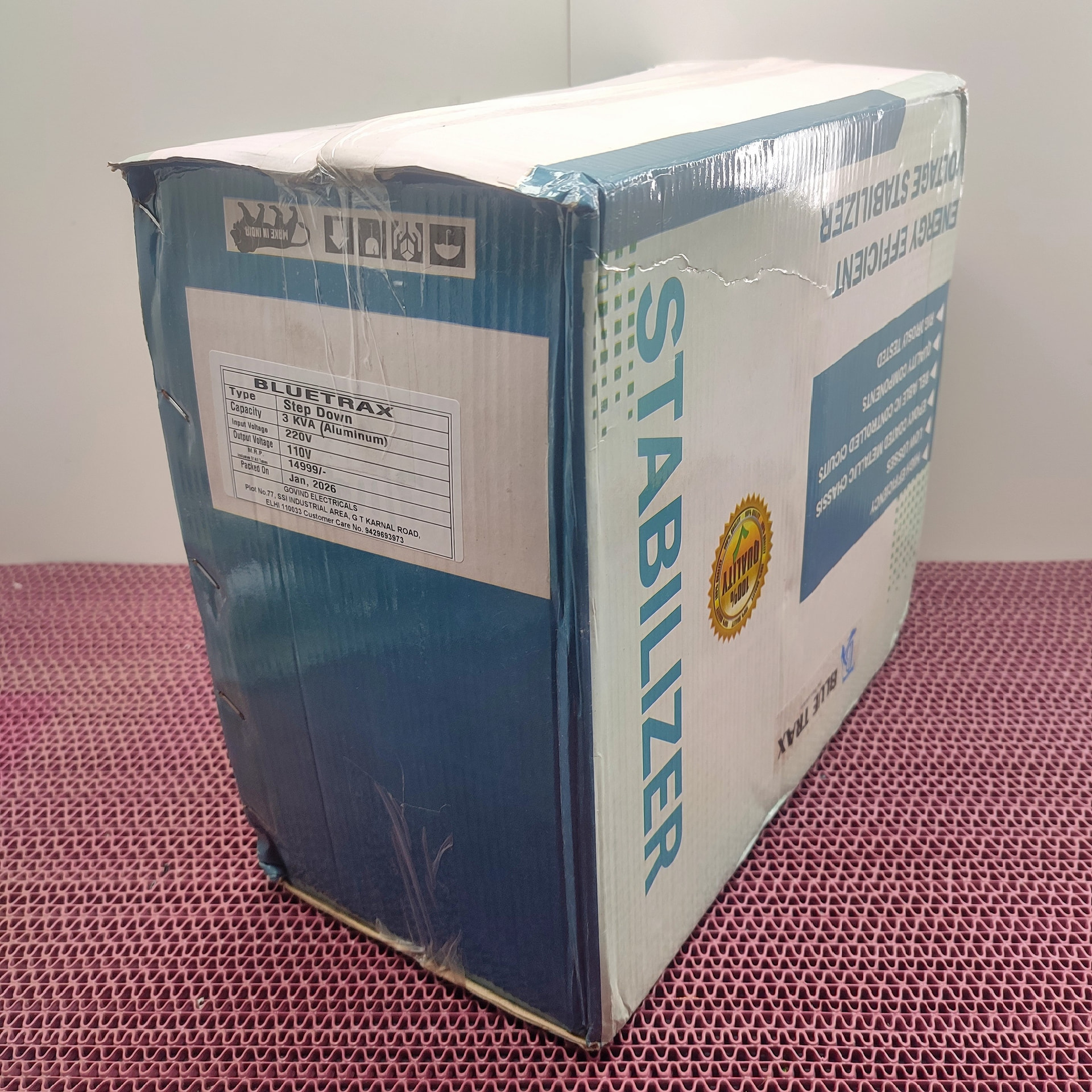
That label says it’s an aluminum unit, ah well that might explain why I got it for a good price.

Let’s take it out:

Somehow the label says it’s a stabilizer? And it looks like it has a toroidal transfer, those are pretty cool.

But look at this, did I get a secret upgrade?

Apparently it’s an electronic voltage step-down stabilizer, whatever that could be.

I don’t see any warranty void stickers, so let’s look inside:

Yep, that looks like copper to me.

It is pretty messy and sparse inside and there’s a distinct lack of electronics:
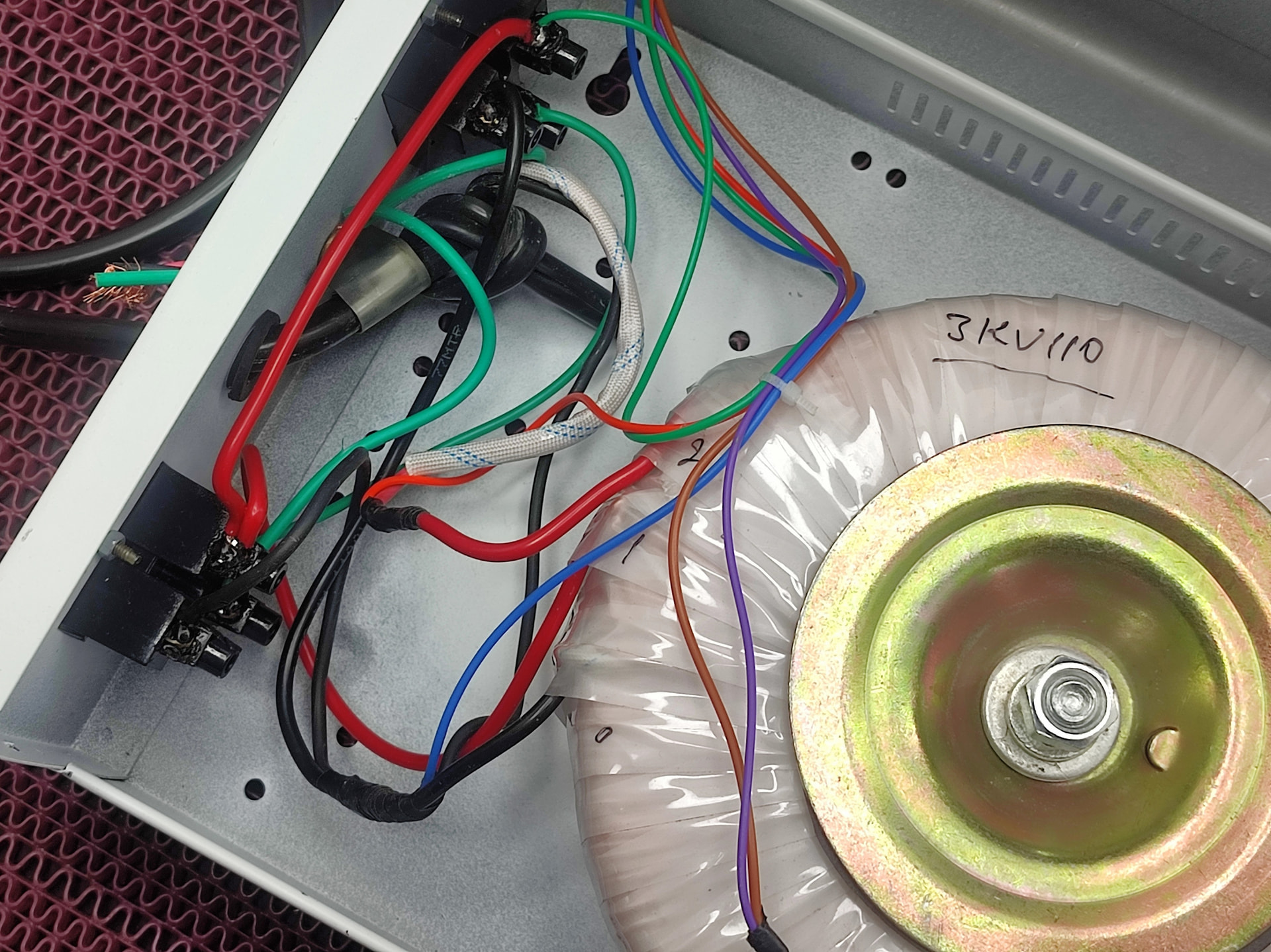
There’s no fuse, no breaker, nothing. This is probably meant to wire directly to your distribution board or something.

Kind of disappointing to see low-cost molded sockets and heavy handed soldering but I guess neither are deal-breakers:

And this looks way too complicated to be a simple voltage display, but it is:

I’d rate this company’s workmanship above average.

That’s it for now, the actual review will come later.

5 Likes

It can be both, sometimes the winding wire has copper coating on top of aluminum.

One way to tell is by scraping the wire with something sharp.

3 Likes

I became familiar with CCA because of ethernet cables, it is what differentiates typical budget priced ethernet cables from top end costlier ones.

1 Like

Just curious, what’s the efficiency of such a transformer? Is it less efficient at lower loads and most efficient closer to design load like most power supplies?

Since there’s no electronics, the efficiency curve should be a flat line.

I’ll test that and see.

1 Like

That will add extra cost.
They expect you to use the MCB. I read when power is applied these transformers have huge amount of inrush current, which is normal.

For safety use 16A C-Series MCB, if that trips then that 20A will work.

1 Like

Where does one buy high end Ethernet cables?

Offline shops, ask for d-link original branded ethernet cables which are always priced higher or some other known brand with full copper wires inside & not CCA like most typical best selling ethernet cables from brands like Fedus are (Fedus also has full copper wire ethernet cables but usually they are not available on amazon & also costlier than their CCA ethernet cables).

1 Like

Looks like a plain jane step down transformer with no “stabilization” with 2:1 winding?

What will happen if you supply 110v into the output port? will you get 220v output from the input port?

1 Like

65%. The efficiency of the transformer will increase until the core is saturated, and then drop due to copper losses. Best performance should be achieved at about 75-85% load, depending on how the transformer is wired up but the efficiency is normally quoted as an average of 65% for a linear supply. There are some losses due to the diodes in such a supply (absent here) so it should be a bit more efficient depending on the load.

The efficiency is also quoted with a linear, resistive load, but most kitchen appliances are hardly that. Typically you will see a little lower efficiency depending on the PF of the load.

Startup current of a 3kVA transformer will be in excess of 20 Amperes. A soft start circuit is more or less mandatory for such large cores in domestic circuits.

Yes, you will get a voltage on the output. Unfortunately for maximum efficiency the winding will be further away from the core (primary is wound first for better magnetisation of the core) so efficiency and power output will be much less.

4 Likes

Thanks, I’m going to some load testing in a bit and
I’m really curious about the efficiency numbers and your information gave me a baseline of what to expect.

I oversized this intentionally, the load is around 1000W.

US appliances are usually on 15A circuits so that’s max load of around 1650W or ~7.5A at 220V (napkin math assuming perfect efficency).

I really loved reading your explanation.

2 Likes

I might also mention that just looking at the height of the transformer, it is not close to 3kVA. I might estimate it at just under 1kVA actually.

The largest we use is 1.6kVA and it’s twice the size of the one in this device. The height of the core is the giveaway here.

Here is a 1kVA isolation transformer inside a prototype (not a shipping unit, that will be cleaner inside) mains conditioner we designed for an OEM. Key is the ratio between the socket and the transformer because there’s a lot of other stuff in here. As you’ll see, the sizes are quite similar to the one inside your device, maybe ours is a fraction larger.

1 Like

Well, that sucks to know. I’ll need to to investigate this and weigh the unit. Transformers typically have a 200% surge rating, yeah? The 3000VA could be a surge rating, making the transformer 1500VA, but sounds like it’s a lot lower than that even.

But now I guess the pricing is making a lot of sense.

Do you know what the cost price is for those transformers you’ve mentioned? 1kVA and 1.6kVA?

It’ll help to get some frame of reference.


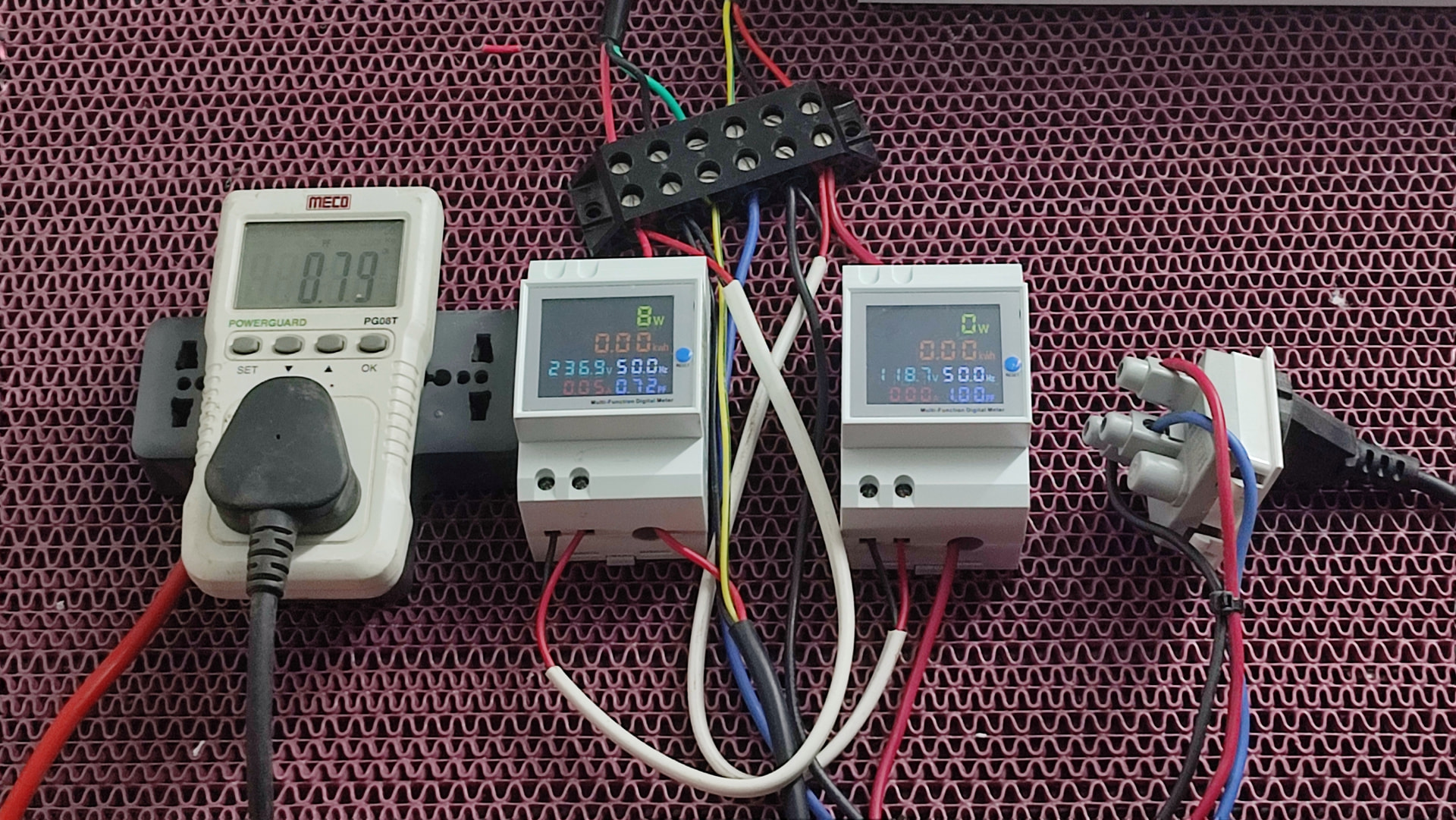
I did some testing, here’s the setup:

A Meco power meter as reference, two power meters for comparing input and output power.

No load power draw looks to be 8W:

I think that’s core losses plus whatever that display is consuming.

Here’s a purely resistive load, an IR bulb:

9W loss with a 53W power draw, total 62W.

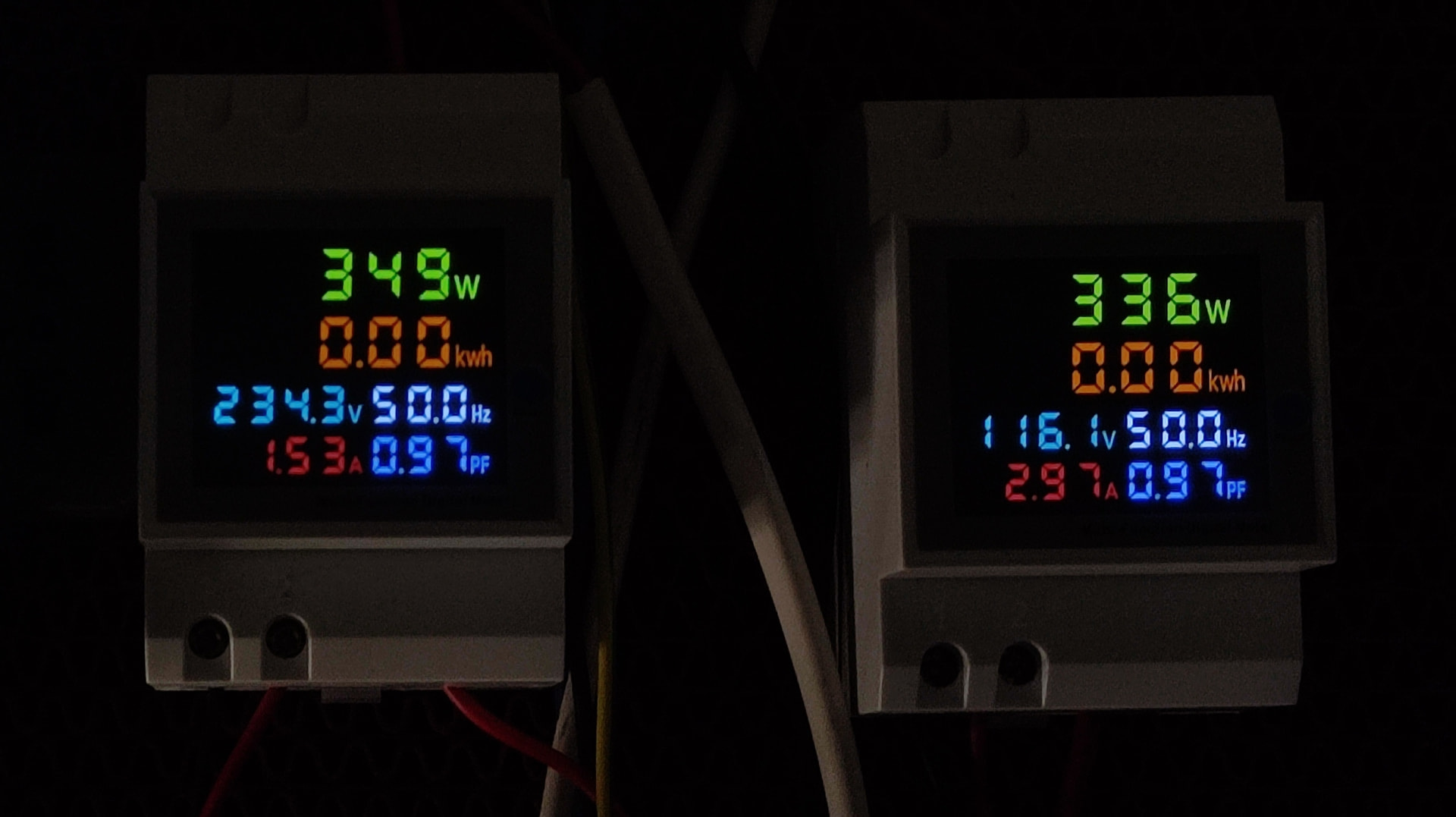
A vaccuum cleaner, so an inductive load:

13W loss at 336W power draw, total 349W.

And the largest load I can find now, a dryer (inductive + resistive):

21W loss at 544W power draw, total 565W.

This one is a little suspicious, the dryer pulls 1800W at the wall at 240V, with a 2:1 winding you’d expect half but it’s closer to a quarter.

Let’s play with some equations.

P = V²÷ R so R = 240² ÷ 1800 = 32.

Solving for a 2:1 winding, P = 120² ÷ 32 = 450W

That’s close enough to the 544W measured since the calculation assumed a purely resistive load while the actual load is a motor and a heater.

I’m not sure what these numbers mean beyond that the efficiency looks pretty good here.

If we take core losses as fixed (no idea if this is true, but let’s go with it for now) then that bulb load is about >99% efficient (don’t want to say 100%).

The vaccum load would be >98% efficient (336+8)÷349.

The dryer load would be >97% efficient (544+8)÷565.

I guess this rules out aluminum or CCA as the winding? So that’s a positive, woo. Maybe.

I’m relieved I oversized this.

1 Like

I was expecting to see a power factor of 60%. lol.

I believe that losses will increase at higher loads if the system is continuously operated for an extended period, correct? Just from the built-up heat, I mean.

I don’t know enough to be sure of that but yes heat build up equals power loss.

But the numbers look good even though it appears that all my assumptions were not true and my expectations were not met.

That’s just hilarious to me.

The last time I ordered a 1.6kVA was around 2017, I think those were about 6-7k each. Price is almost 2x now.

No, it would be a quarter. Power is proportional to square of voltage, or if the voltage is halved for the same load it draws half the current. So a reduction to 25%. This is normal.

Much better than expected but you need to get the load up to the sag point. The voltage at the output is key to all of this.

Well maybe but we’re nowhere near the rated power, so you’ll only know then.

Yes, copper resistance will go up with temperature and increase the losses. At some point you’ll hit a wall. Transformers are designed around this wall.

2 Likes