If the supply estimate from retailer is big per time period (day/week/month) and steady, the margin may be high
If the market has a lot of competitors, they can negotiate for higher margin if they can convince they have large captured customer base
They get special benefits (incentives, rewards & recognition which may be in cash or kind, free products) during seasonal promotion or if they satisfy certain targets by brand / distributor
Not sure about pharmacy industry specifically, but some industries get subsidies from govt afaik (if woman owner of shop, selling a particular product, selling in a particular region etc)
Some cross sell products which may subsidise the original product.
If they are part of a company which owns a larger part of the supply chain, then their overall margin increases hence opportunity to discount increases.
If the owner has another cash cow business from where he / she can subsidise
I’ve given you some possible reasons for discounts which are common in most industries. If you’re looking at pharma, it really depends on the product afaik.
In pharmacy business, the main cost is the initial cost of producing the chemical formula and ensuring the efficacy (this involves the R&D, clinical trials, patents etc). Once that is set, the branding, marketing and supply chain incurs a relatively smaller cost. Once patented - I think for 20 yrs - you can sell your product at your choice of price (naturally at a high margin)
You can also evergreen a pharma product by changing a very small part of the chemical formula, convince the relevant regulatory body that it’s a new product (there is a better scientific term for this but I can’t remember right now), patent it again (and sell it again at high margin). Once the patent expires and if you don’t evergreen, that’s when any other company can copy your chemical formula, make it and sell it under generic medicine. Naturally the cost now is much lesser, so if you are able to build a brand for a generic medicine, there is possibly even higher margin.
These were not generic medicines, also as far as I know dawadost sell just regular medicines and don’t really do much generic stuff. You might be confusing then with davaindia.
I may be wrong - I haven’t dug deep enough into this particular company’s business model.
As per website of dawaadost (please excuse me if I’m mentioning the wrong company here)
“We understand the financial burden that high medicine prices can place on individuals and families. That’s why we offer trusted, branded generic medicines from brands like Cipla, Alkem, Abbott, and Glenmark, etc., at prices that are at least 50% lower than traditional pharmacies.”
The above aligns to what I just talked about building brands under generic medicines allowing higher margins.
That is the correct website, and the medicines that I purchased from them were not generic. They were the same brand as the doctor prescribed and same as the ones I had purchased at full price previously from normal pharmacy.
I am not aware of what branded generic is. They also list this on their website
Branding is different - it is a marketing concept. If you own a company xyz and say you want to sell paracetamol (which is generic), you can create a product line for paracetamol under brand name abc. Then you can create ads to tell the pitch to the end consumer or incentivise the doctor to tell the customer during consultation “get the paracetamol abc”
Even better… say you’re Cipla and many of the end consumers know that you’re a big pharma company having other well known medicine. Your company name itself is a brand. You can just sell any generic paracetamol and you can expect it to sell better as compared to any other smaller company’s generic paracetamol. Because the end consumer will (mostly) assume if any product belongs to Cipla, it’ll be good.
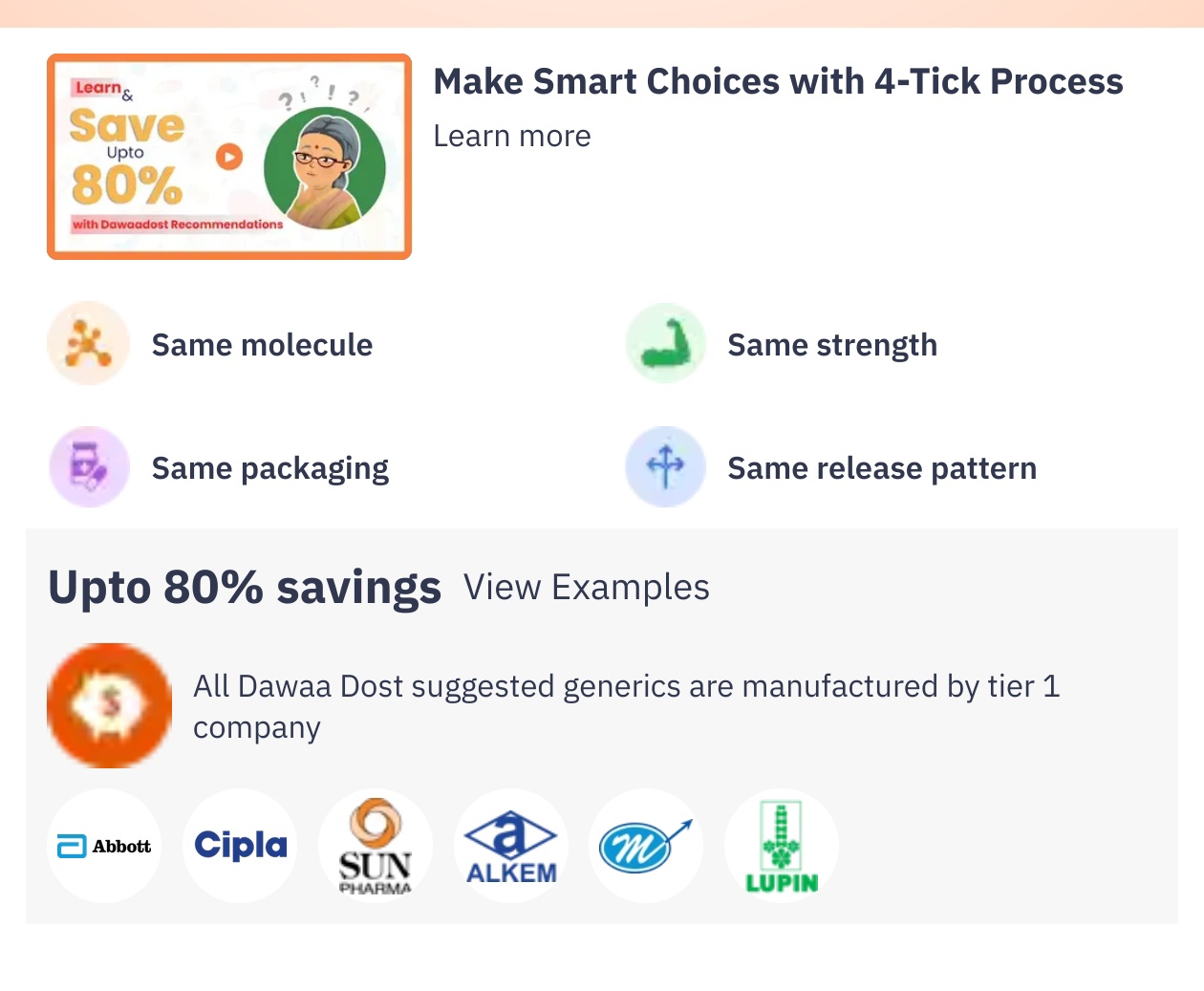
The image is the concept of how generic medicine are similar to patented medicines.
If you bought - say - the exact same crocin (which is a medicine brand) at much much lower price at davaadost as compared to other pharmacy shop, it could be due to the many reasons I listed in my first reply - how organisations can increase their margins. Beyond that, we will need to check out their business model
From my experience (used to run a business years back), pharmacy margins aren’t the same across the board.
For normal branded meds, shops usually have around 15–25% margin on the MRP, while distributors/stockists only get about 6–12% on MRP. Bigger pharmacies that buy in bulk or directly from manufacturers skip some of those middle layers, which lets them give better discounts while still keeping their margins.
Another big factor is branded generics. Companies push them with freebies and schemes—like “buy 10 strips, get 2 free.” A high-volume pharmacy can use those schemes to drop prices for customers but still stay profitable.
Surgical and medical devices are a whole different game. Margins there are huge—often 50% to several hundred percent on MRP—so if a shop sells both medicines and surgical items, they can afford to throw in big discounts and still do well overall.
That doesn’t mean there’s never anything shady in the market, but in most cases it’s just about scale and smarter sourcing.
The margin in branded medicines is usually to the tune of 30% to 40% depending upon the volume one purchases.
Source is a family member who is running a wholesale medical supply shop since the past 50 years (2nd generation family business) and supplying to small hospitals and nursing homes.
I buy branded medicines for my mother from MedPlus (mostly available in South India) with a straight discount of 20% on the MRP (for meds bought above Rs. 1000/-). My mother’s neurosurgeon has advised not to switch to generics, and use only the branded innovator drugs which are way too priced higher.
MedPlus has an online website. See if the prices they offer are lower as compared to your present vendor. We have 6 stores in our city and I prefer to pick things up in person as opposed to getting them online.
They don’t offer as good discounts on Supplements, nutraceuticals, etc. to make up for the loss on medicines. MedPlus has recently started pushing their own generics too, to make up for loss in margins.
The idea is to get the customer in the door, and then upsell him other products in which they have better margins. Economies of scale help them pull in good business.
My father and his brother goes to the same medical shop since the last 50 years and they get 20% discount on branded medicines.
My father or his brother does not use generics at all.
While me, my wife and my kid have CGHS cards so we take what is given to us from our DAE Dispensary.
Between 2014-19, TDP party which was in power was allegedly involved in a medicines scam by supplying medicines and other medical equipment to the state goverment hospitals which were of low quality.
Nobody speaks about this it’s like it never happened. I mean the major media channels in the country.
Many have amassed 100-1000 of crores from this and other scams during that period.
It’d be a scandal for all the Andhra & Telangana pharmaceutical and allied industries. All these facilities which cater to the exports markets are often in news for the wrong news. We never know what kind of crap goes into our bodies.
Even the big Indian names now have most popular formulations contract manufactured and it’s the same player supplying to multiple brands. We pay as per the brand. Do check the manufacturing details and you will see what I am referring to.
The MRPs of the medicines are inflated, and the shops make a lot of money, more than you may assume. There was an antibiotic for a urinary infection, and one of my friends needed 10 doses of it. The MRP of one bottle of the antibiotic was 1200 Rs, so the doctor gave us a contact number of a supplier. The supplier gave it for around 800Rs per bottle. The regular shop would have sold it for at least 1150. So they make a lot of money even if they sell at deep discounts.
You’re missing a point that applies to all goods sold with inclusive tax, including the medicine example you gave. The supplier gave it at 800, assuming no margin was kept. When that same strip goes to a retailer (who has invested in shop, storage, staff, and other running costs) sells at 1150, that margin is not just free profit, it also covers those expenses. Since medicines have tax included in the MRP, the manufacturer already factors in costs from production until the product reaches the end customer. That’s how the 1200 MRP is fixed. From there, it’s up to the people in between—supplier, distributor, retailer—to decide how much the customer finally pays.
If everyone starts selling things at MRP, we are doomed. Check out the MRPs of RAMs, CPUs and other things. Even a tyre usually sold at 1500Rs comes with an MRP tag of 4000Rs.
Medicines are high margin business. The margins are such that even a mom pop store can earn approx 10-20L on 30-50L sale per year.
Medplus etc are great as they give 20% discount. But recently to make up for the loss to normal shops prices of meds have increased. In short you’re back to where you began.
When buying meds check the drug, check which company made the drug and if original one is available. The tests were done on this exact drug manufactured a particular way. Generics or biosimilars have to do a small bridge trial in india. Given the corruption you never know.
Also go you’re in a hospital and injections above 1K are prescribed, please do the above and 1000% make sure you check the price of original and the generic one if hospital is giving generic.
Most big hospitals have generics now. Funny thing is these generics are more expensive than the original drug. 1 such drug was an antibiotic by pfizer. Original costed 10k per inection. Mofos at hospital giving 17k generic injection.
Happened twice. First time we didn’t know original or duplicate. It was an anti fungal again original drug from pfizer. And just fought as to why after 2 days they shifted to a 17k injection. They said they ran out. I told them that’s their problem, we will pay for original and asked to get original. They did from next day.
Second time with antibiotic they gave generic for 2 days then the doc says make sure they give original. And we fought and got it. Took me 2 hrs of shouting at 20 different people but managed it. Further research showed that was the antibiotic of last resort. Imagine giving a patient generic when giving the antibiotic of last resort for an infection that was resistant to EVERY DRUG. Almost k-word a few of these hospital buggers that day.